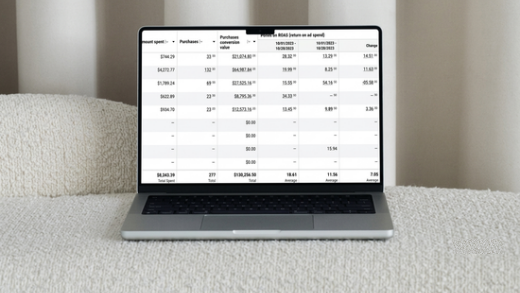


Your Meta ads were performing well, but now they are not.
Costs have increased, sales have slowed, and dashboard performance has declined each week. It is easy to blame Meta and assume it is not performing for your business, but that conclusion often comes too soon. However, Meta is rarely the underlying issue.
However, Meta itself is rarely the underlying issue.
As a Meta ads agency in Brisbane, Patch frequently assists brands experiencing declining ROAS. We advise that a drop in ROAS is a symptom, not the root cause. Instead, the underlying issue may lie in your creative, offer, website, tracking, sales process, or recent changes to your ads.
Below are the seven most common causes we observe, with the checks that help identify each one.
The following scenarios are illustrative examples based on observed patterns across multiple accounts. They do not represent individual client results.
This is the most common cause.
Every ad has a limited lifespan. When audiences repeatedly see the same ad, engagement declines. Click-through rates decrease, cost per purchase increases, and frequency rises.
A common scenario: An online skincare brand runs three ads launched in the same week. Initial ROAS was 4.2; after eleven weeks, it dropped to 2.6. Audience frequency reached 4.8, and CTR halved. The campaign itself was not at fault; the audience had grown fatigued. After introducing new hooks, formats, and customer-led videos, ROAS recovered to 3.7 within a week. Start by refreshing creative gradually; changing too much too fast on your Meta account can be risky because it may send the account back into the learning phase.
What to check:
If your top-performing ad is three months old, this is likely the cause.
Solution: Maintain a consistent flow of fresh creative ideas, including new angles, hooks, and formats. Avoid simply reusing the same image with minor changes.
At times, the cost of reaching your audience increases for reasons beyond your control.
Peak periods such as Black Friday, the end of the financial year, and Christmas drive CPMs higher. Increased competition for the same audience results in higher costs for all advertisers.
What to check:
If CPMs have increased but your conversion rate remains steady, market conditions have shifted. However, if both CPMs and conversions decline, additional factors may be involved.
Solution: Stronger creativity can reduce costs by increasing engagement. While you cannot control the auction, you can improve the quality of your ads to achieve better results.
Ads have limitations. If your offer isn’t compelling, you are paying to show something your audience doesn’t want.
Offers can become less effective over time. Competitors may undercut your pricing, and customers may become accustomed to your discounts. Strategies that worked previously may no longer deliver results.
A common scenario: A furniture retailer offered “10% off your first order” for over a year, with conversion rates declining each quarter. A competitor began offering free delivery and 60-day returns. The retailer switched to free delivery, retained the same ads, and saw conversion rates recover without changing the creative. Check the offer before changing the campaign.
What to check:
Solution: Test a new offer before overhauling your entire campaign. A stronger incentive to purchase often outperforms improved creativity alone.
Securing a click does not guarantee a sale.
If your ad’s CTR remains strong but conversions have declined, review the post-click experience. Slow load times, confusing layouts, cumbersome forms, or messaging that doesn’t align with the ad can all hurt results.
A common scenario: A fitness studio maintains a strong ad CTR, but bookings decline following a website redesign. The new page takes six seconds to load on mobile, and the booking button is now positioned below extensive text. The ads were effective; the landing page was causing the drop-off. Check the post-click experience first.
What to check:
Most Meta traffic occurs on mobile devices. If your page is optimised only for desktop, you are likely losing potential customers. That is why the mobile experience should be reviewed before making other changes.
Solution: Address landing page issues before adjusting your ads. This is often the most cost-effective improvement.
We’ll look at your Meta setup, creative, funnel and performance data to help find where the drop is actually happening. Talk to Patch
This issue is especially important for lead generation brands.
Your cost per lead may look favourable. However, if leads do not respond, attend appointments, or make purchases, your actual return is much lower than reported.
Meta will optimise for the lowest-cost conversions unless directed otherwise, often producing low-intent leads who complete forms without genuine interest.
A scenario we see often: A home renovation business is getting leads at $22 each. The sales team says most of them are tyre-kickers, and only 1 in 40 turns into a job. The business switches to a longer form with a budget question and a clearer price range on the landing page. Cost per lead rises to $48, but 1 in 12 now becomes a job. The lead got more expensive. The customer got much cheaper. Check lead quality, then connect it to sales results.
What to check:
Solution: Introduce qualifying steps where beneficial. Enhanced questions, transparent pricing, and stronger messaging attract higher-quality leads. Where possible, provide Meta with actual sales data to improve lead targeting.
In some cases, ROAS has not actually declined; it is simply being measured inaccurately. As a result, reported performance can look significantly better or worse than reality.
Privacy changes, browser restrictions, and tracking errors can prevent Meta from recording every sale. Such issues may cause reported results to appear significantly better or worse than reality.
A common scenario: An e-commerce brand observes a Meta-reported ROAS drop from 3.5 to 1.8 in one week, while store revenue remains stable. A checkout plugin update disrupted the purchase event, causing Meta to miss approximately half of the attributed sales. The campaigns were effective; the reporting was inaccurate. Check tracking before reducing the budget on the reported drop.
What to check:
If the numbers do not align, avoid making significant decisions until the data is corrected.
Solution: Implement a robust server-side setup, ensure accurate event tracking, and regularly compare Meta’s reporting with your actual revenue.
Rapidly doubling your budget seldom results in a proportional increase in outcomes.
Big jumps can push campaigns back into learning. They can also push your ads to colder, less relevant audiences. As a result, ROAS drops, and the campaign gets blamed for a budget-setting decision.
A common scenario: A brand achieves a consistent 3.4 ROAS on a $150 daily budget. After increasing spend to $500 per day over a weekend, ROAS drops to 2.1 within days, prompting the team to pause all campaigns. Gradual scaling in 20 to 30 percent increments, combined with new creativity, would have maintained stronger performance. Check budget changes before blaming the campaign.
What to check:
Solution: Scale incrementally. Increase your budget gradually and introduce new creative ideas with each step.
A low cost per lead may look advantageous, but this is often misleading.
Here’s a simple example. If you pay $15 per lead and 1 in 50 becomes a customer, each customer costs you $750. If you pay $60 per lead and 1 in 10 buys, each customer costs you $600.
In this example, the higher-cost lead provided greater value.
The most important metric is cost per customer and the value each customer brings. Cost per lead is only an intermediate measure. Focus on metrics that directly impact revenue, rather than those that simply look favourable in reports.
Before increasing your budget, review the following checklist:
Before you spend another dollar, run through this list:
Allocating additional budget to an ineffective funnel will only accelerate losses.
A ROAS decline rarely has a single cause. It is typically the result of multiple factors, which vary by business.
Brands that recover most quickly take a comprehensive approach, analysing the entire customer journey from initial impression to final sale.
As a digital marketing agency in Brisbane, we will review your Meta setup, creative, funnel, and performance data to identify the source of the decline.
Ask any Brisbane business owner what keeps them up at night, and a fair few will mention the same thing:...
Content either stops the scroll or it doesn't. Patch Studio sits in the middle of that gap for Brisbane brands,...
Planning an event usually means juggling a dozen moving pieces: the venue, the guest list, the styling, and the drinks....
The guest list might be identical. So might the budget and the catering. But put those same people in a...
Every reservation, event enquiry and website visit is an opportunity to build a longer relationship. Social media may introduce someone...